
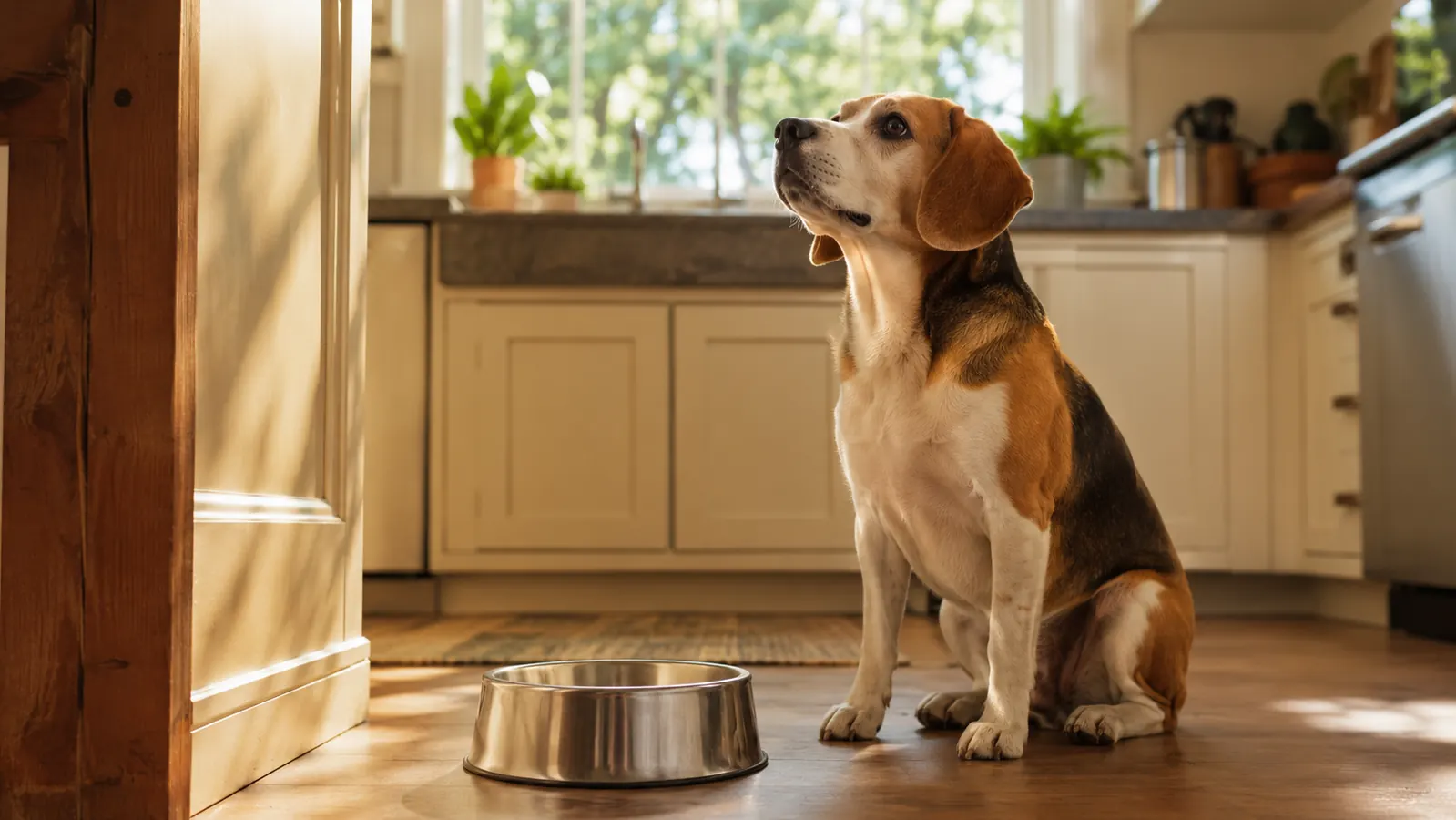
Our dog Murphy, a beagle mix we've had since he was a pup, could clear a bowl of kibble faster than I could pour it. I am not exaggerating. He would hit the bottom of the bowl in what felt like three seconds flat, and then he would stand there watching me like I had shorted him, tail going, hoping for a second helping.
For a long time I told myself it was just puppy enthusiasm that he would grow out of. He didn't. By the time he was two, the habit was locked in. I tried feeding him smaller portions spread through the day. I tried putting a big smooth stone in the middle of his bowl so he had to work around it. Nothing slowed him down for more than a meal or two, and the stone trick only worked until he figured out how to shove it aside with his nose. In the middle of all that I started reading about slow feeder bowls, and the name that kept coming up was Outward Hound. I just had not acted on it yet.
What finally made me change things was a Saturday morning I would rather forget. I had just filled his bowl and turned to grab my coffee. By the time I looked back he had inhaled everything, and about twenty seconds later he threw the whole meal back up on the kitchen floor. The second time in a week he had done it. My husband looked at me and said, plain as day, that we had to do something about the way this dog eats.
I have learned over many years of owning dogs that when they eat too fast, they swallow air along with the food, and that air is what makes them uncomfortable, gassy, and sometimes sick. It isn't just messy. For a deep-chested dog it can turn into something far more serious that no one wants to deal with. The more I read, the more I realized a fast eater is a problem worth fixing, not a quirk to shrug off.
If your dog finishes dinner before you sit down, a slow feeder bowl is the fix worth trying first
It slows a fast eater without you having to hover over every meal. See today's price and check if it fits your dog's bowl and size.
Amazon Check Today's Price on Amazon →The first night with the raised maze bowl, Murphy went from finishing in seconds to taking a full ten minutes, and he did not get sick once.
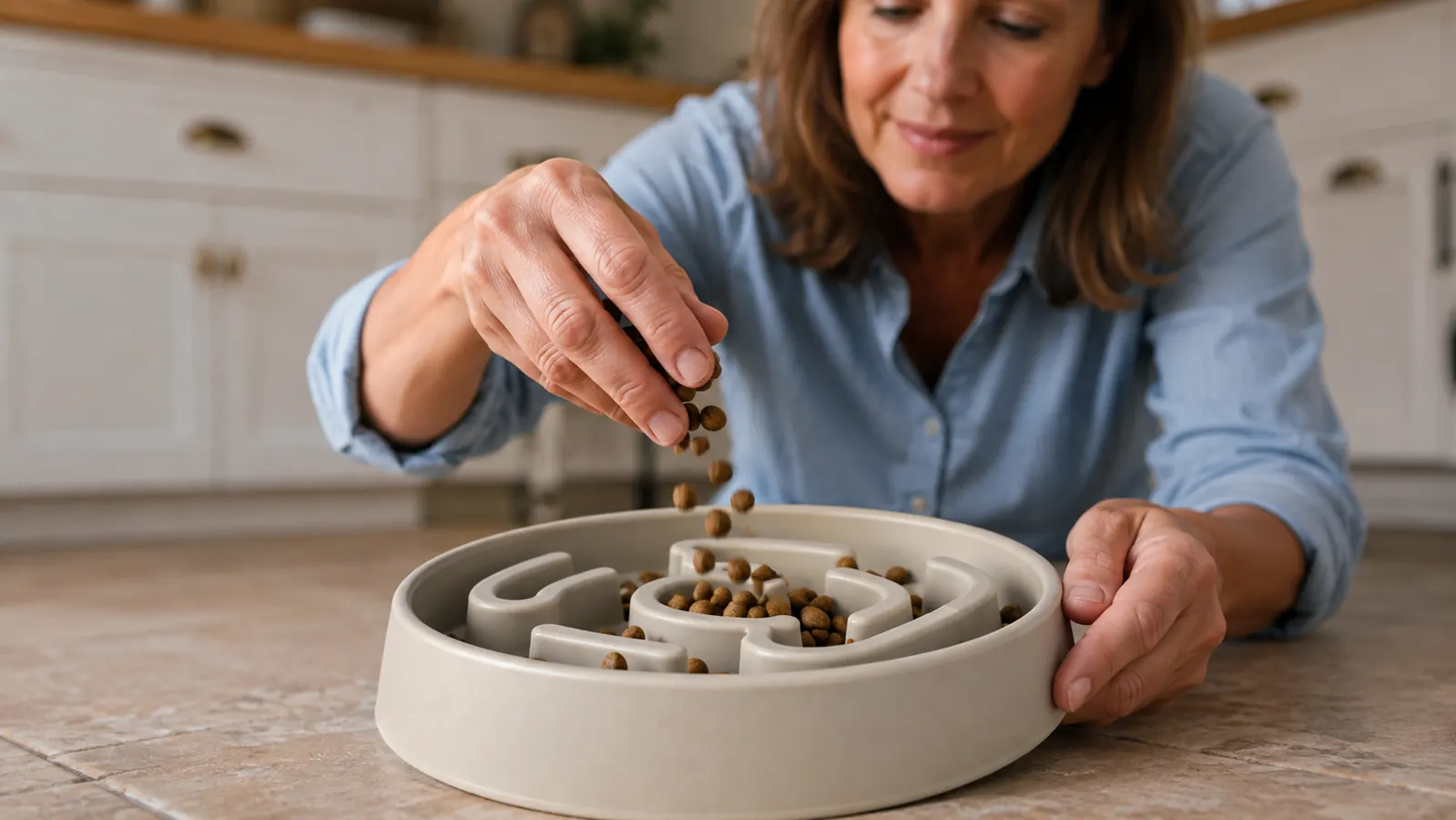
So I ordered an Outward Hound slow feeder bowl. It is a sturdy bowl with a raised maze of ridges and pockets inside, so the food doesn't sit in one open pile where a dog can vacuum it up. Instead, a dog has to work each piece free, nosing it out of the little valleys one mouthful at a time. It sounded simple, and in practice it is, which is exactly why it works.
The first night, I filled it the same way I always had and set it down. Murphy walked up, sniffed it, and went right in. The difference was immediate. He could not just wolf everything in one pass. He had to move his head around the maze, duck for each piece, and actually chew. What used to take him seconds stretched out to a good ten minutes. When he finally finished, he sat back and looked at me, and I realized I had not seen him eat a meal that slowly since the day we brought him home.
The best part is what stopped happening. No more meals ending in a horked-up mess on the floor. No more gulping air with every bite. He eats, he's done, and he trots off to his bed like a normal dog instead of lying there looking miserable. That alone was worth the switch, and it happened from the very first bowl.
A couple of things are worth knowing before you buy one, because I like to be straight about this stuff. The Outward Hound bowl does take a little longer to clean than a plain one. Those ridges trap bits of food, and you have to run a brush or your fingers through them to get every corner. It is not hard, just one extra step. And some very determined dogs will still flip the bowl if they get frustrated, though the non-slip base on this one has kept ours right where we set it. If your dog is a real master at tipping bowls, you may want to rest it against the wall or pop a mat under it.
We are about three months into it now, and Murphy takes his time at every single meal. He still gets excited when he hears the bag open, but the eating itself has turned calm. My husband even comments on it sometimes, which for him is basically a standing ovation. Whatever magic was in that first bowl has not worn off, and that is the thing that convinced me this wasn't a fluke.
What I'd Tell You If We Were Sitting at My Kitchen Table
If you've got a dog that inhales food the way ours did, I'd tell you not to wait until he's sick in the middle of the floor like we did. A slow feeder bowl is one of the cheapest, simplest things you can buy for a fast eater, and it works on the very first meal. It doesn't take training. It doesn't take willpower. The bowl just makes it physically harder to gulp, and the dog adapts in about five minutes.
I wouldn't run out and buy the most expensive thing out there, either. Start with a simple, well-made one that fits your dog's bowl size, give it a week, and watch. Our Outward Hound slow feeder has earned its place on our kitchen floor, and if you've got a fast eater, I think it'll earn one on yours too. Your dog's stomach, and your floor, will thank you.
Slow your fast eater down starting tonight
A slow feeder bowl is an easy, inexpensive way to calm mealtimes for good. Check today's price and find a size that fits your dog.
Amazon Check Today's Price on Amazon →